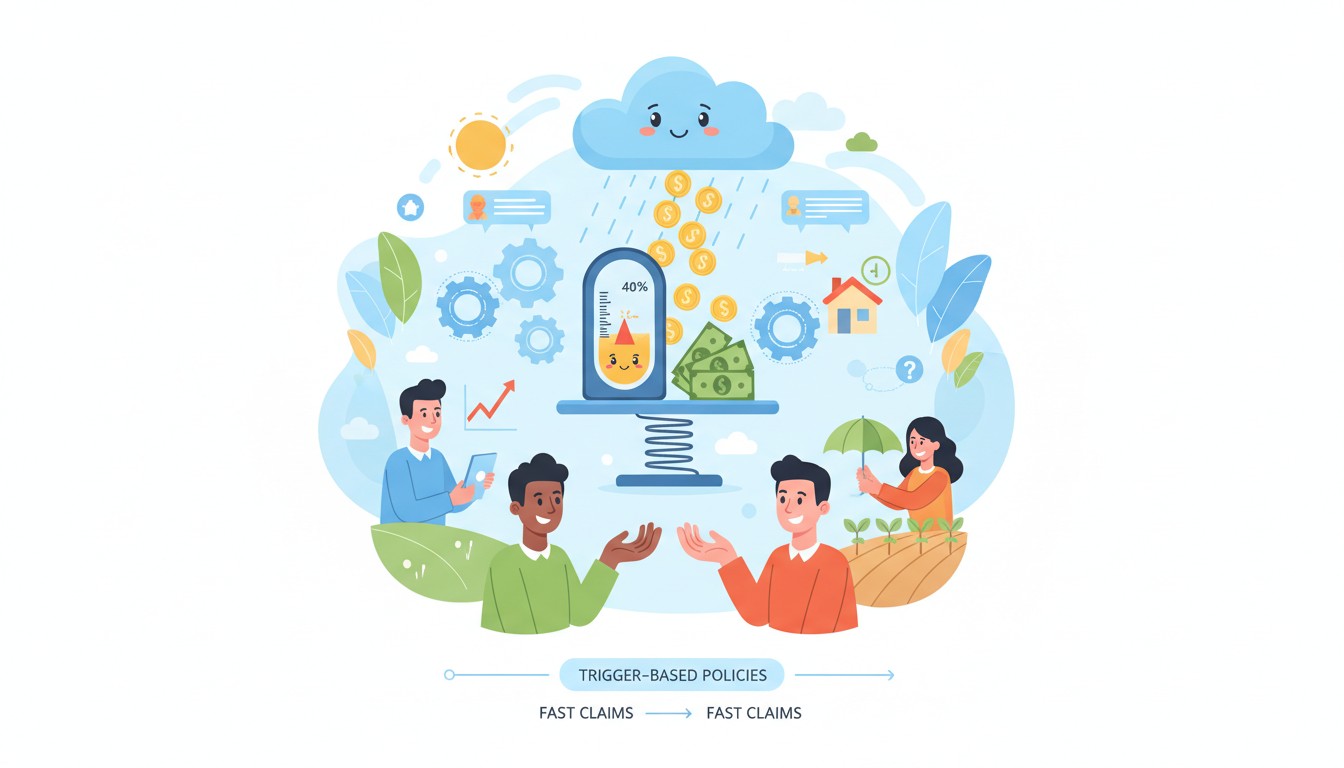
The insurance claims that most intimately affect business survival aren’t processed in sprawling claims centers—they’re executed by algorithms monitoring wind speeds, river gauges, and seismic sensors. Parametric policies pay out not when damage is assessed, but when pre-defined triggers are met: a hurricane of specific intensity within a defined radius, rainfall below a critical threshold, an earthquake exceeding a certain magnitude. Yet research from insurance industry studies shows that fewer than 8% of risk managers fully understand parametric structures, and adoption among small businesses remains below 15%.
This knowledge gap creates a brutal paradox: the fastest, most transparent form of disaster recovery remains overlooked while businesses drown in traditional claims limbo. While we obsess over policy premiums and deductible negotiations, trigger-based solutions offer near-instant liquidity that can mean the difference between reopening and permanent closure. Understanding how parametric insurance operates—and learning to wield it—transforms you from a passive claimant waiting on adjusters into an active architect of your financial resilience.
The Invisible Architecture: How Trigger-Based Policies Work
Every aspect of parametric insurance rests on a foundation of objective measurement. The policy doesn’t ask “how much did you lose?” but rather “did the event exceed our agreed threshold?” This fundamental shift eliminates the subjective nightmare of traditional claims—no haggling over depreciation, no disputes about repair costs, no waiting for three contractor estimates. The parameter is king.
Consider something as specific as wind speed measurement. A parametric hurricane policy might define its trigger using data from the National Hurricane Center, tracking sustained winds within a predetermined radius of your business location. When a named storm’s eye passes within 40 miles and wind speeds exceed 130 mph, an automatic payment of 75% of your policy limit transfers to your account—often within days, sometimes within hours. No adjuster needs to inspect your shattered windows; the wind gauge at the nearest NOAA station already confirmed your payout.
This trigger architecture extends far beyond weather. A construction company building a stadium can buy parametric coverage against excessive rainfall days—each day precipitation exceeds 0.5 inches triggers a $50,000 payment for delay penalties. A city government can purchase policies that pay $1 million when snowfall accumulates over 20 inches in 72 hours, immediately funding emergency snow removal without waiting to calculate actual costs. The parameter becomes a proxy for loss, correlated closely enough to provide meaningful protection while eliminating claims friction.
The cumulative effect of these micro-triggers creates macro-resilience. Businesses with parametric coverage recover operations 60% faster after disasters, according to Milliman research. They don’t waste precious weeks documenting losses while bills pile up. They receive immediate capital to pay employees, rent temporary space, and restart revenue streams. The difference isn’t incremental—it’s existential.
The Trigger Tree: What Parameters Control Your Payout
Meteorological: Wind speed, rainfall intensity, snowfall depth, temperature extremes
Geological: Earthquake magnitude, ground shaking intensity, volcanic eruption thresholds
Hydrological: River water levels, storm surge height, drought indices
Economic: Commodity price drops, tourism decline indices, infrastructure disruption metrics
The Psychology of Claims Delay: Why We Accept Inefficiency
If parametric insurance offers such obvious advantages, why do businesses cling to traditional policies? The answer lies in a combination of inertia bias, risk misperception, and institutional lock-in that trains decision-makers to favor the familiar over the optimal.
The Inertia Bias: We’re Drawn to Tradition
Traditional insurance operates like a comfortable ritual—file claim, wait for adjuster, negotiate settlement, receive payment. This process feels safe precisely because it’s slow and deliberate. Parametric insurance, by contrast, feels almost too fast. The idea of receiving a $500,000 wire transfer three days after an earthquake triggers cognitive dissonance: “Where’s the catch?” Our brains are wired to distrust efficiency that seems to bypass due diligence.
Insurance brokers reinforce this bias. They’ve spent decades mastering traditional policy language and claims processes. Parametric structures require new expertise—understanding data providers, correlation models, and basis risk. This knowledge gap creates professional discomfort, leading many brokers to recommend what they know rather than what’s best for clients.
The Complexity Mirage: When Simplicity Feels Suspicious
Traditional insurance policies run hundreds of pages dense with exclusions, conditions, and definitions. This complexity creates an illusion of comprehensiveness—surely something so detailed must offer better protection. Parametric policies, often just 10-15 pages, seem simplistic by comparison. The straightforwardness feels like a vulnerability rather than a feature.
This perception ignores that complexity often serves insurers, not insureds. Dense policy language creates gray areas that can be interpreted in the carrier’s favor during disputes. Simplicity in parametric insurance reflects clarity of intent: we agreed on a trigger, the trigger happened, here’s your money. Transparency becomes a feature, not a bug.
The Basis Risk Fear: Misunderstanding the Trade-off
Critics of parametric insurance rightly point to “basis risk”—the possibility that your actual loss doesn’t align with the parametric payout. A hurricane might hit just outside your defined radius, or winds might be slightly below the threshold despite severe damage. This risk is real but often overstated. Traditional policies carry their own basis risk: exclusions for flood when you thought you had water damage coverage, depreciation calculations that slashed your expected payout, or simple claims denial.
The difference is that parametric basis risk is transparent and quantifiable upfront. You can model exactly how often a storm will fall just short of your trigger. Traditional basis risk hides in policy fine print, revealing itself only after disaster strikes when you’re too desperate to fight.
Traditional vs. Parametric: A Tale of Two Claims
The true revolution of parametric insurance becomes visible when you compare two identical disasters affecting two different businesses. The divergence in recovery trajectories reveals why triggers are transforming risk management.
Both companies suffer similar damage from a major hurricane. Both have $2 million in business interruption losses. But their claims experiences diverge the moment the storm passes. Company A files a traditional claim, triggering a six-month odyssey of documentation, negotiation, and depreciation calculations. Company B’s parametric policy automatically initiates payout when NOAA data confirms Category 4 winds within the defined radius. Within 30 days, they have $1.5 million in their account—no adjuster required.
This speed advantage compounds. Company B can immediately pay crews to begin repairs, securing scarce contractors before demand peaks. They can reassure employees with continued payroll, retaining talent while competitors furlough staff. They can order materials before supply chains bottleneck. By the time Company A receives its settlement, Company B has been operational for four months, capturing market share from competitors still waiting for insurance checks.
The Recovery Timeline: A Side-by-Side Comparison
Day 1 (Disaster): Both suffer damage; Parametric trigger automatically activates
Day 30: Parametric payout received ($1.5M); Traditional claim still in initial assessment
Day 60: Parametric company resumes 75% operations; Traditional company still documenting losses
Day 120: Parametric company fully operational; Traditional company receives initial settlement offer (80% of claimed amount)
Day 180: Parametric company has captured 15% additional market share; Traditional company finally agrees to final settlement
Real-World Impact: Parametric Victories That Reshaped Recovery
Abstract concepts become concrete through examples. These case studies demonstrate how trigger-based policies transformed disaster response from reactive scramble to proactive resilience.
The River Cruise Company That Stayed Afloat
A European river cruise operator faced a critical problem: droughts were dropping water levels below navigable depths, canceling cruises and devastating revenue. Traditional insurance offered no solution for this “non-damage” business interruption. The company purchased a parametric policy that paid a fixed daily amount whenever water levels at a designated gauge fell below a defined threshold. During a severe drought, they received $50,000 per day automatically, allowing them to refund customers, pay staff, and maintain solvency until rains returned. The policy didn’t just cover losses—it preserved the business through immediate liquidity.
The Municipality That Kept Roads Clear
A Colorado city faced budget chaos from unpredictable snowstorms. When snowfall exceeded 20 inches in 72 hours, snow removal costs would explode, forcing diversion of funds from other critical services. They purchased a parametric policy that paid $1 million at the 20-inch threshold, scaling up to $2 million for 40-inch events. During a record-breaking storm, the policy paid out in four days, funding emergency contractors and salt purchases. Residents experienced safer roads faster, and the city avoided fiscal crisis. The trigger transformed unpredictable catastrophe into manageable budget line-item.
The Caribbean Hotel Chain That Rebuilt First
After a Category 5 hurricane devastated multiple resorts, one hotel chain with parametric coverage received $5 million within three weeks based on wind speed data alone. While competitors waited months for adjusters to document every broken window, they immediately hired reconstruction crews, who completed repairs 50% faster. They reopened for peak season, capturing tourist dollars that competitors couldn’t serve. The parametric payout didn’t just cover damage—it funded competitive advantage. Three years later, their market share in the region had grown 22%.
The Compound Effect: Long-Term Resilience Accumulation
Parametric insurance operates like compound interest for resilience—each rapid recovery builds organizational capacity that makes future disasters easier to withstand. A business that receives immediate payout after one hurricane can invest in hardening infrastructure before the next season. They can afford backup systems, diversified suppliers, and emergency capital reserves. Each trigger event funds improvements that reduce vulnerability to subsequent events.
This accumulation effect explains why early parametric adopters report not just faster recovery, but reduced overall losses. A hotel chain that rebuilt with parametric funds after one hurricane used superior materials and designs, suffering 40% less damage from a subsequent storm three years later. Their initial parametric policy effectively funded loss reduction investments that traditional insurance would never cover.
The encouraging corollary is that any business can begin this accumulation process. You don’t need to be a Fortune 500 corporation with dedicated risk managers. Small businesses can purchase parametric micro-policies covering their most critical vulnerabilities—$50,000 when local river flooding exceeds a certain depth, $25,000 when winds top 100 mph. These small, consistent investments in trigger-based protection accumulate into genuine organizational resilience over time.
Practical Strategies: How to Activate Parametric Protection
Understanding parametric insurance is useless without action. Here are concrete strategies for moving from traditional vulnerability to trigger-based resilience.
Start With Your Critical Risk
Don’t try to parametrically cover everything. Identify your business’s single greatest disaster vulnerability—hurricane exposure for a coastal business, drought for agriculture, excessive rain for construction. Focused coverage beats diffuse protection. Your specific risk provides authentic motivation and allows you to model exact correlation between parameter and loss. Resources like risk assessment tools can help quantify this exposure.
Model Your Loss Correlation
Before purchasing, analyze historical data to understand how tightly your potential loss correlates with the proposed parameter. A Miami hotel’s business interruption correlates strongly with hurricane wind speed. A Kansas wheat farm’s yield correlates tightly with summer rainfall totals. The stronger the correlation, the lower your basis risk. Use free data from NOAA’s climate data or USGS seismic records to build your own correlation models.
Structure for Liquidity, Not Perfection
Accept that parametric insurance won’t cover every dollar of loss. Structure payouts to provide immediate liquidity for your most critical cash flow needs—payroll, emergency repairs, customer retention. Think of it as a bridge loan that activates automatically. A construction company might cover delay penalties but not full reconstruction costs. A hotel might cover three months of operating expenses but not total rebuilding. This liquidity focus aligns parametric protection with survival priorities.
Combine With Traditional Coverage
The most powerful approach isn’t parametric OR traditional—it’s parametric AND traditional. Use parametric insurance for rapid liquidity while traditional policies cover detailed loss documentation and final settlement. This hybrid model gives you the best of both: immediate capital to survive plus comprehensive indemnification to fully recover. Many carrier solutions now offer integrated packages designed for this complementary approach.
Negotiate Data Provider Terms
The trigger is only as reliable as its data source. Ensure your policy specifies a reputable, independent agency—NOAA for weather, USGS for earthquakes, official government gauges for water levels. Include backup provisions if primary sensors fail. Define how disputed measurements will be resolved. These technical details determine whether your trigger fires when you need it most.
The Future Is Triggered
The parametric insurance revolution isn’t coming—it’s already here, quietly paying claims in 30 days while traditional policies crawl through six-month adjustor reviews. The businesses that thrive after disasters aren’t those with the most coverage; they’re those with the fastest capital. Speed is the new protection.
Your power to transform risk management doesn’t depend on being a large corporation or having specialized expertise. It depends on one decision: to stop accepting claims delay as inevitable. The trigger you need is measurable, objective, and waiting to be activated. Your competitor is already modeling it. Your neighbor already has a policy. The only question is whether you’ll keep filing traditional claims while others rebuild.
The parametric future offers no adjustors, no negotiations, no delays—just data-driven decisions and immediate recovery. The trigger has been pulled. The question is whether you’re ready to receive the payout.
Key Takeaways
Parametric insurance pays based on pre-defined triggers (wind speed, rainfall, earthquake magnitude) rather than loss assessment, enabling payouts in days instead of months.
Cognitive biases like status quo preference and complexity illusion keep businesses locked in slow traditional claims, despite parametric’s proven 60% faster recovery advantage.
Real-world applications—from river cruise drought protection to municipal snow removal—demonstrate parametric’s power to preserve businesses and public services through immediate liquidity.
Effective parametric strategies focus on critical risks, model loss correlation, structure payouts for liquidity needs, and combine with traditional coverage for comprehensive protection.
The parametric revolution offers transparent, data-driven claims processing that transforms disaster response from reactive struggle to proactive resilience—speed is the new competitive advantage.